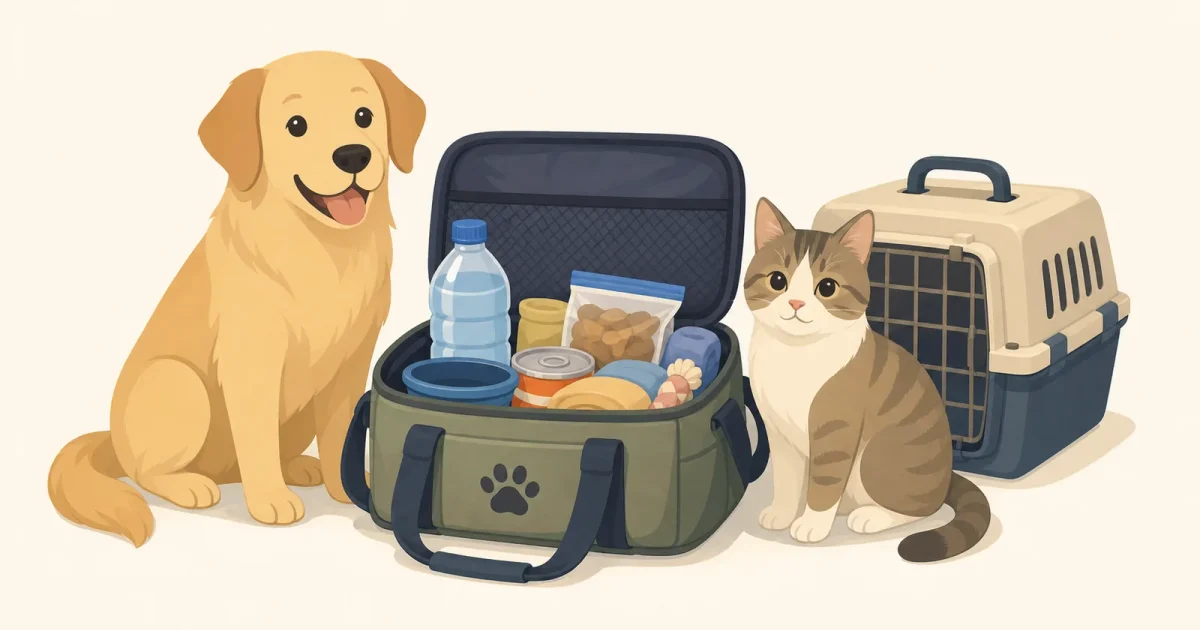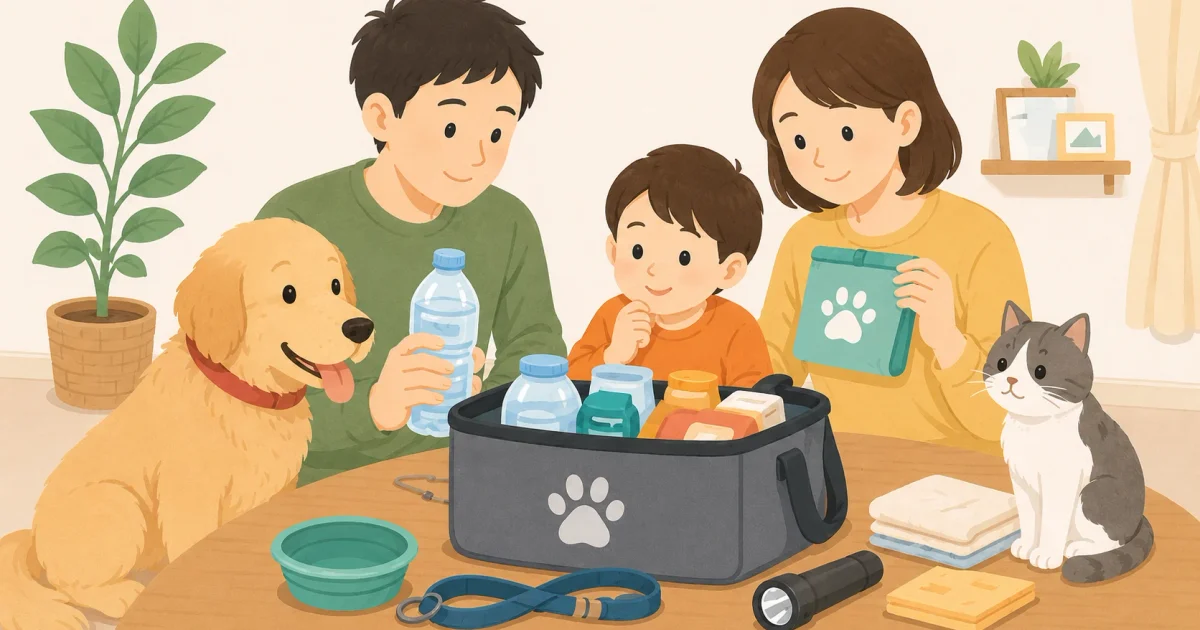
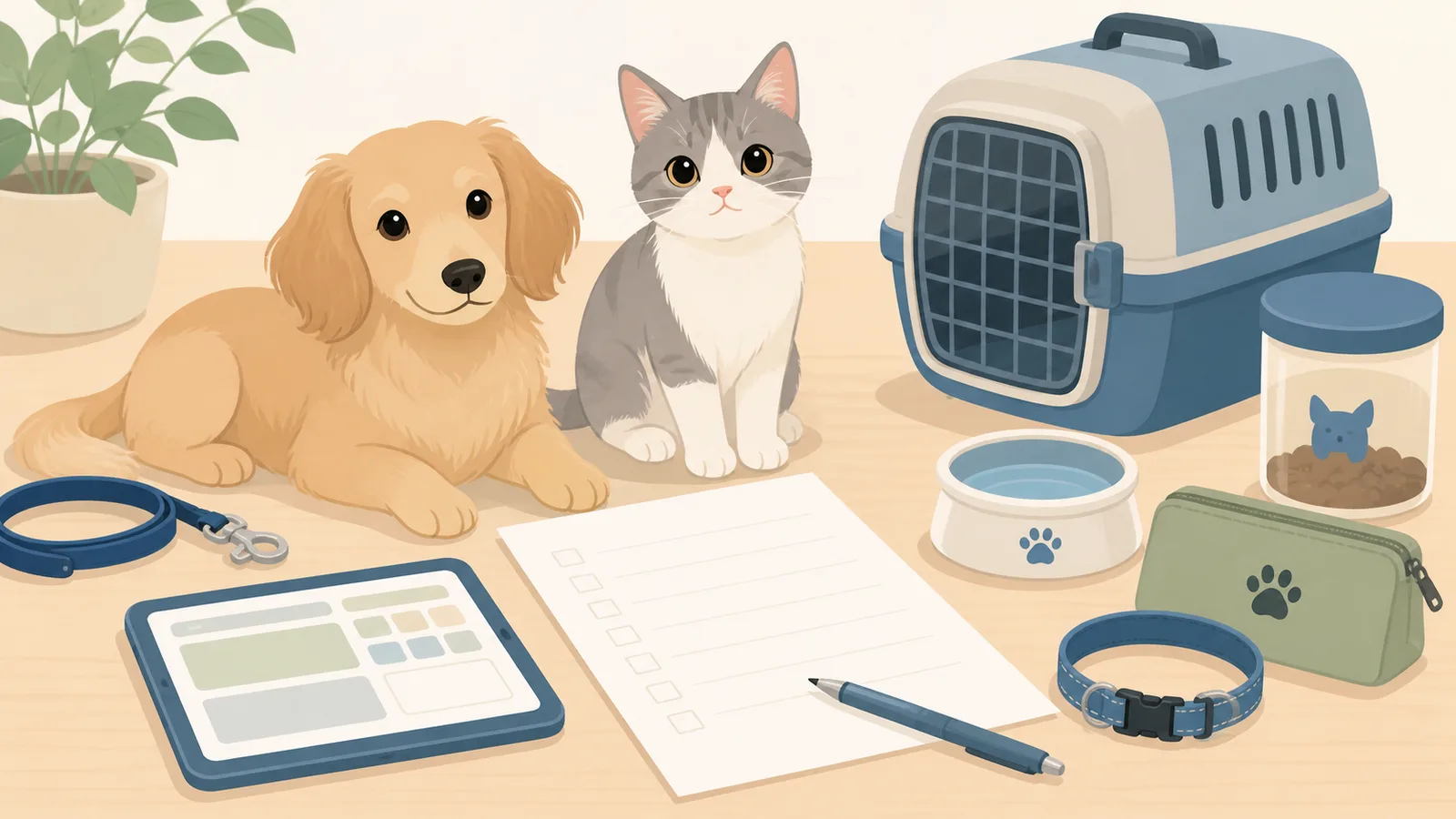
During a disaster, dogs and cats need their own food, water, toilet supplies, carriers, and identification items in addition to your household emergency supplies. In some evacuation settings, pet supplies may not be available in sufficient amounts.
This guide organizes the estimated cost of dog and cat disaster-preparedness supplies in Japan by separating “using items you already own” from “buying the minimum set from scratch.” Prices are rough planning estimates based on official information and retail listings checked on 2026-05-24. Actual costs vary by store, online marketplace, size, shipping fee, sale timing, region, and season.
Key takeaway
If your household already has a carrier and toilet supplies, adding food, water, and consumables may cost around ¥3,000–¥7,000. If you are preparing a minimum set from scratch, it is easier to plan around about ¥9,000–¥20,000 for a dog and about ¥7,000–¥16,000 for a cat.
Japanese government and municipal information commonly uses at least 5 days of pet food and water, ideally 7 days or more, as a preparedness benchmark [1][2][4]. However, each municipality and evacuation site may handle pets differently. Check not only the cost, but also your local rules for evacuating with pets.
What this article covers
- Estimated costs for dog and cat disaster-preparedness supplies
- Items to check for a 5–7 day stock
- Cost items that differ between dogs and cats
- A checklist before taking supplies to an evacuation site
- Disaster-preparedness costs that are easy to miss when using annual cost calculators
Assumption: evacuation sites may not have pet supplies
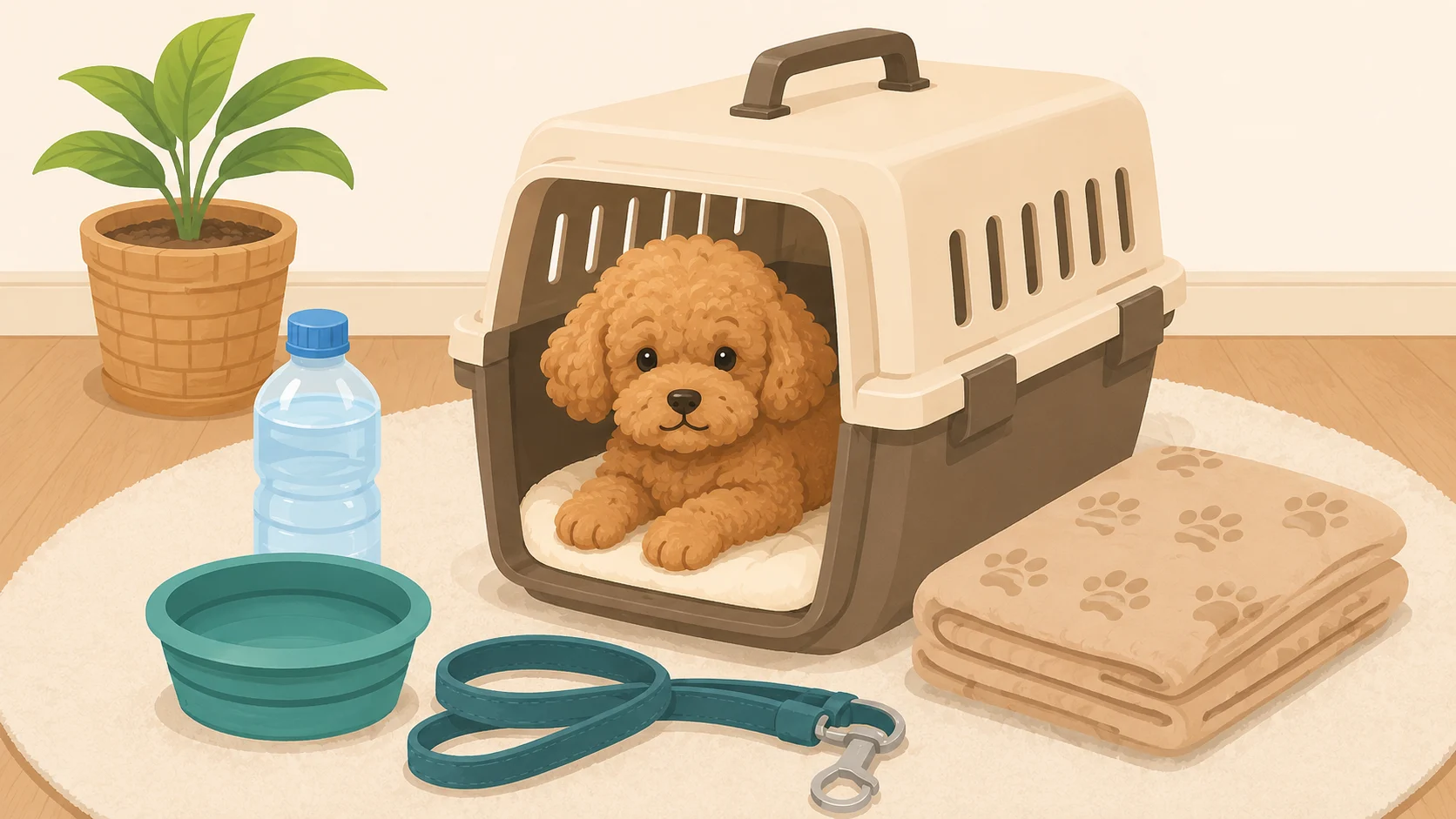
Keeping extra everyday food, water, and toilet supplies makes preparedness easier to maintain.
Whether you can evacuate with a pet, where the pet will stay, and whether pet supplies are stocked depends on the municipality and the evacuation site. Bunkyo City explains that pet food and similar supplies are not stocked at evacuation sites, so owners need to prepare their own evacuation set [2]. Edogawa City also explains that evacuation sites do not stock pet supplies and asks owners to bring pet food, bowls, carriers or cages, toilet supplies, and similar items [3].
For that reason, this article estimates costs on the assumption that the owner prepares 5–7 days of supplies rather than relying on supplies being available at the evacuation site.
Overall cost picture
| Preparation pattern | Main items | Estimated cost | Best fit |
|---|---|---|---|
| Add only consumables | Food, water, potty pads, cat litter, waste bags, records | About ¥3,000–¥7,000 | Households that already have a carrier, collar, and leash |
| Prepare a minimum dog set | Carrier, food, water, potty pads, waste bags, collar, leash, bowls, ID items | About ¥9,000–¥20,000 | Households that recently adopted a dog or are preparing disaster supplies for the first time |
| Prepare a minimum cat set | Carrier, food, water, litter, waste bags, collar or harness, bowls, ID items | About ¥7,000–¥16,000 | Households that recently adopted a cat or want to prepare evacuation items |
| Add a cage or foldable pen | Foldable pen, cage, supplies for car evacuation or temporary stay | Additional ¥7,000–¥30,000 | Multi-pet households, large dogs, car evacuation, or temporary care planning |
This table is a rough estimate based on retail prices available on 2026-05-24. Actual costs vary by pet size, the food your pet usually eats, whether therapeutic food is needed, housing environment, and local evacuation-site rules.
Supply-by-supply checklist
The price ranges below are rounded planning ranges based on checked listings for dog food, cat food, carriers, foldable pens, odor-control bags, and water-supply items [6][7][8][9][10][11].
| Item | Estimated cost | What to check |
|---|---|---|
| Food | Dog: about ¥1,000–¥3,000 / Cat: about ¥800–¥2,500 | Keep 5–7 days of the food your pet normally eats. Avoid switching suddenly during an emergency. |
| Water | About ¥400–¥1,000 for 2 L × 6 bottles | Add your pet’s portion on top of household drinking-water stock. |
| Carrier | About ¥3,000–¥7,000 | Check body size, weight capacity, and how securely the door closes. |
| Foldable pen or cage | About ¥7,000–¥30,000 | Choose based on whether you are planning for an evacuation site, staying home, car evacuation, or temporary care. |
| Potty pads | About ¥800–¥1,600 per pack | Mainly for dogs, but also useful as a backup for cats. |
| Cat litter and cat toilet consumables | About ¥500–¥1,600 per bag or pack | Stock the litter your cat is used to. A small amount of used litter may help some cats feel more secure. |
| Waste bags and odor-control bags | About ¥400–¥1,000 | Prepare on the assumption that owners handle pet waste at the evacuation site. |
| Collar, leash, or harness | Dog: about ¥1,000–¥5,000 / Cat: about ¥500–¥2,600 | Cats may also need a harness in some situations. Let pets get used to it gradually. |
| Bowls and portable water items | About ¥400–¥1,500 | Choose lightweight items that are easy to wash. |
| ID tag | About ¥700–¥1,500 | Check contact information, dog license tag, rabies vaccination tag, and microchip information. |
Food and water are consumables, so it is easier to continue preparedness by keeping a little extra of what you already use and replacing the older stock first. You do not need to buy everything at once. Start with items that protect life and health, then add the rest step by step.
What changes between dogs and cats
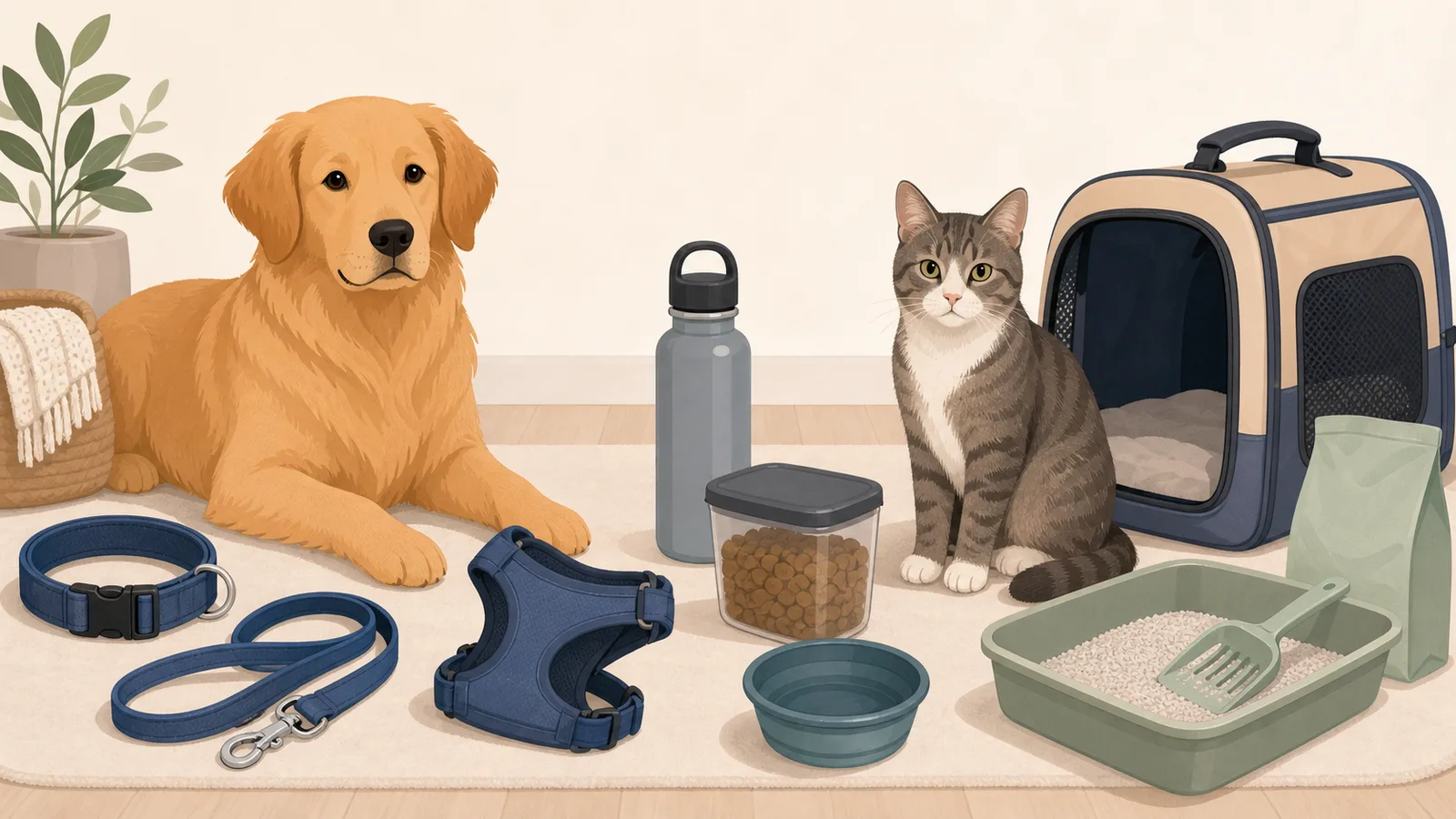
Dogs and cats need slightly different checks during evacuation planning.
For dogs, leashes, collars, harnesses, and waste-cleanup items are especially important during evacuation. Depending on the municipality, a dog license tag and rabies vaccination tag may also need to be checked. The Ministry of the Environment material lists owner identification for dogs, including a collar and ID tag, dog license tag, rabies vaccination tag, and microchip [1].
For cats, practice with the carrier and preparation of litter or a temporary toilet are especially important. The Ministry of the Environment material also lists owner identification for cats, including a collar and ID tag and microchip [1]. Because cats may be sensitive to environmental changes, consider keeping the carrier visible at home and preserving a small amount of familiar litter.
What changes by municipality and housing situation

Evacuation-site rules differ by municipality, so check them before an emergency.
The pet species accepted, where pets stay, whether cages are required, and whether pet supplies are stocked all differ by municipality and evacuation site. Kita City explains that evacuation sites have some cages and dog/cat food stock, but supplies are limited and owners should generally prepare and bring their own items [4]. Shinjuku City lists pet food and water, toilet supplies, routine medication, cages, leashes, harnesses, owner identification, and photos as disaster-preparedness items [5].
In apartments or rental housing, also check what happens if elevators stop, whether stairs are realistic, and what rules apply in common areas. Large dogs, multi-pet households, and pets that need therapeutic food or routine medication may need more supplies and therefore higher preparation costs.
Quick checklist when you are not sure
- Do you have at least 5 days, ideally 7 days or more, of food and water?
- Has your dog or cat practiced entering a carrier or cage?
- Can you use a collar, leash, harness, and ID tag immediately?
- For dogs, can you confirm the dog license tag and rabies vaccination tag?
- Is the microchip information and contact information up to date?
- Do you have enough potty pads, cat litter, and waste bags to carry out?
- Have you gathered medication, therapeutic food, health records, and vaccination records?
- Do you have recent pet photos both on your phone and in printed form?
- Have you checked your municipality’s rules for evacuation with pets?
- Have you considered several options, such as staying home, temporary care, a relative’s home, or car evacuation?
Use related tools for household planning
Disaster-preparedness supplies are not monthly bills, but they can become a lump-sum cost soon after adoption or when items need replacement. When you estimate annual dog or cat costs, it helps to keep carriers, emergency stock, and toilet-supply top-ups as a separate line item.
Start with the Pet emergency supply cost calculator for Japan to estimate a rough top-up cost from pet type, number of pets, stock duration, and items you already have.
For dogs, use the Dog cost calculator for Japan. For cats, use the Cat cost calculator for Japan. Enter disaster-preparedness purchases as setup supplies, other costs, or a separate note so the first-year and review-period costs are easier to understand.
FAQ
How many days of pet disaster supplies should I prepare?
Official and municipal guidance commonly uses at least 5 days of pet food and water, ideally 7 days or more, as a benchmark [1][2][4]. If your pet needs medication or therapeutic food, if you have multiple pets, or if shopping access may be difficult, consider preparing more.
Do I need to buy more if I already have a carrier and toilet supplies?
You do not need to buy everything again. First check whether your carrier is undamaged, correctly sized, and easy to take out quickly. Then add consumables such as food, water, waste bags, potty pads, and cat litter to prepare at a lower cost.
Are pet supplies available at evacuation sites?
It depends on the municipality and the evacuation site. Some municipalities, such as Bunkyo City and Edogawa City, explain that pet food or pet supplies are not stocked at evacuation sites [2][3]. Check your own municipality’s official information and prepare on the assumption that the owner brings the necessary supplies.
Do cats need a leash or harness too?
They may be needed during evacuation or transport. However, cats may become stressed if unfamiliar gear is used suddenly. Instead of only buying a harness, let your cat get used to a carrier or harness gradually and safely.
Is buying a ready-made disaster kit enough?
A ready-made kit can be a useful starting point, but each pet’s size, familiar food, medication, toilet preference, and local rules are different. Do not treat a kit as complete by itself. Check food, water, toilet supplies, owner identification, and health records for your own dog or cat.
Notes and limitations
The costs in this article are rough estimates based on official information and retail listings checked on 2026-05-24. Actual prices vary by store, online marketplace, size, material, shipping fee, sale timing, region, and season.
Pet acceptance, pet areas, items to bring, and cage rules at evacuation sites vary by municipality and site. Before preparing, check the latest information from your local municipality. For therapeutic food, medication, chronic conditions, or health-related preparation, consult your veterinarian.
Sources and checked information
| No. | Source name / page title | How it was used in this article | Checked date |
|---|---|---|---|
| [1] | 環境省「人とペットの災害対策ガイドライン 一般飼い主編」 | Basis for 5–7 days of supplies, evacuation items, owner identification, and carriers/cages | 2026-05-24 |
| [2] | 文京区「人とペットの災害対策 - 避難行動」 | Evacuation-site stock conditions and the assumption that owners prepare an evacuation set | 2026-05-24 |
| [3] | 江戸川区「ペットの災害対策」 | Example of an evacuation site where pet supplies are not stocked and items owners should bring | 2026-05-24 |
| [4] | 北区「災害時における避難所へのペットの同行避難」 | 5-day minimum and 7-day preferred stock benchmark, and an example of limited stock | 2026-05-24 |
| [5] | 新宿区「ペット防災について」 | Pet food and water, toilet supplies, routine medication, cages, and owner-identification checks | 2026-05-24 |
| [6] | カインズ「犬用ドライフードのおすすめ商品一覧」 | Dog food price range check | 2026-05-24 |
| [7] | カインズ「猫用ドライフード 1kg以上のおすすめ商品一覧」 | Cat food price range check | 2026-05-24 |
| [8] | カインズ「Pet’sOne ペットキャリー 縦型」 | Carrier price and weight-capacity example | 2026-05-24 |
| [9] | カインズ「折りたたみメッシュサークル ベージュ Mサイズ」 | Foldable pen price and size example | 2026-05-24 |
| [10] | カインズ「ペット用消臭・ペット掃除用品 商品一覧」 | Waste bag and odor-control supply price range check | 2026-05-24 |
| [11] | カインズ「ドリンクノズル・給水器のおすすめ商品一覧」 | Portable water item price range check | 2026-05-24 |
| [12] | PlanWise Guide「ペット費用」カテゴリ | Connection check with existing articles and tools | 2026-05-24 |